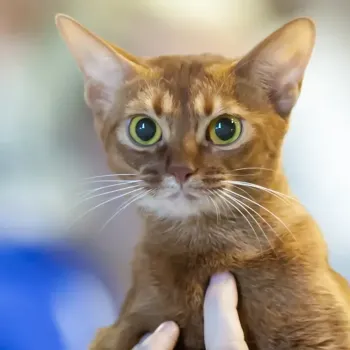
The Abyssinian is a breed of cat recognised by FIFe (ABY). It is one of the oldest cat breeds, although its exact origins remain unclear. The name refers to Abyssinia, present-day Ethiopia, yet the modern form of the breed developed in Great Britain. Genetic research suggests possible connections between the breed's ancestors and cats that inhabited the coasts of the Indian Ocean. The most distinctive characteristic is the ticking of the coat—alternating light and dark bands on individual hairs that create a subtle, shimmering effect.
The Abyssinian is one of the oldest cat breeds, though its precise origins have not been definitively established. The breed's name derives from Abyssinia, now known as Ethiopia, but the contemporary form of the breed was developed in Great Britain. Genetic studies indicate possible links between the ancestors of this breed and cats that inhabited the shores of the Indian Ocean.
Adult female Abyssinians typically weigh approximately 2.7 to 4 kg, whilst males weigh 3.2 to 5.5 kg. Despite their slender appearance, they possess strong musculature. The body is harmonious, resilient and well-muscled. The legs are long and slender, with small, oval paws. The tail is fairly long, broader at the base and gradually tapers towards the tip. The head is moderately wedge-shaped with gentle, rounded contours. The ears are large, broad at the base and slightly rounded at the tips, set well apart from one another. The eyes are large, almond-shaped and expressive, in shades of green, yellow or amber, with a darker outline that emphasises the gaze.
The primary coat colours are ruddy (wild) with a warm brown base and black ticking, sorrel with a coppery tone and chocolate-brown ticking, blue and fawn. Each of these colours also appears in a silver variant, in which the hair base is silvery white. The characteristic visual effect is created by ticking—alternating light and dark bands on individual hairs—rather than distinct stripes or spots on the body.
The Abyssinian is typically full of energy and interested in everything happening around it. It readily explores new spaces, observes household members and participates in their daily activities. It forms strong attachments to its owner, though it often expresses affection through companionship and shared activity rather than lengthy rest on laps. It enjoys climbing and appreciates elevated observation points. Many Abyssinians retain a desire to play throughout adulthood and willingly learn new games. Some enjoy retrieving small toys. They can get along well with children, other cats and friendly dogs, though relationships depend on temperament and how the animals are introduced. Their voice often takes the form of a gentle chirping sound, which they use to greet their owner or attract attention.
The coat is short, fine and close-lying to the body, with a distinctly resilient feel to the touch. Grooming is relatively straightforward. Regular brushing with a soft brush helps remove loose hairs. The short coat does not require the intensive grooming that longer-haired cats need, and many Abyssinians actively enjoy the attention they receive during grooming sessions.
Abyssinians can inherit a deficiency of pyruvate kinase, known as PKDef. This disorder can lead to the breakdown of red blood cells and anaemia. The condition varies in progression: some cats show no obvious symptoms for a long time, whilst others develop weakness and loss of appetite. Genetic tests are available to identify the variant responsible for the disease. The breed is also known to carry inherited retinal diseases, including PRA-rdAc, which causes gradual loss of vision. A cat may have normal vision at birth, with problems appearing later. DNA testing helps identify specific disease variants and carriers. It is also worth having the teeth checked regularly, as tartar accumulation can contribute to gum inflammation. Dental checks should be part of routine veterinary care.
| Organisation | Recognised | Breed code | Category |
|---|---|---|---|
| FIFe | yes | ABY | IV |
- Is the Abyssinian suitable for a home with children?
- They can get along well with children, though relationships depend on the cat's temperament and how the animals are introduced.
- How much time should be spent grooming an Abyssinian?
- Regular brushing with a soft brush helps remove loose hairs. The short coat does not require the intensive grooming that longer-haired cats need.
- Do Abyssinians enjoy play?
- Many Abyssinians retain a desire to play throughout adulthood and willingly learn new games, and some enjoy retrieving small toys.
- What are the main health concerns in this breed?
- Abyssinians can inherit a deficiency of pyruvate kinase (PKDef) and inherited retinal diseases (PRA-rdAc). Genetic tests are available to identify these variants. Regular dental checks with a veterinarian are also recommended.
- Does the Abyssinian have a long-haired relative?
- The closely related Somali is the long-haired counterpart to the Abyssinian. Both breeds share the characteristic ticking and a love of activity.