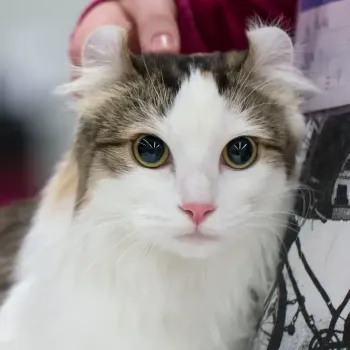
The American Curl Longhair is a cat breed recognised by FIFe. It originates from the United States, specifically California, where it emerged as a result of a spontaneous mutation in a black longhaired cat named Shulamith. The breed's most distinctive feature is its ears, which curve backwards in a smooth arc whilst remaining soft and flexible. This is a medium-sized cat with a harmonious, rather slender build and a silky, semi-long coat. The breed is typically sociable, gentle and enjoys spending time close to its owner.
The American Curl Longhair comes from the United States. The breed's history traces back to California, where a black longhaired cat named Shulamith exhibited ears that curved backwards. This unusual ear shape resulted from a spontaneous mutation and was passed on to some of her offspring.
Adult females typically weigh approximately 2.3-3.6 kg, whilst males weigh 3.2-4.5 kg.
This is a cat with a proportional, elongated body and moderately developed musculature. The legs are of medium length with rounded paws, and the elastic tail is similar in length to the body, gradually tapering towards the tip.
The head is shaped like a gentle wedge, somewhat longer than it is wide. The muzzle features rounded contours, and the nose is straight and of medium length. The eyes resemble walnuts in shape: the upper line is oval, whilst the lower line is more rounded.
The most recognisable feature is the ears, which are broad at the base and curve backwards in a smooth arc. Their rounded and flexible tips remain soft.
The American Curl Longhair occurs in all coat colours and patterns, including solid, tabby, tortoiseshell, silver, smoke, white markings and colourpoint. Eye colour is typically unrelated to coat colour, except in animals with Siamese-pattern markings, where the eyes should be blue.
The American Curl Longhair is typically sociable, gentle and inquisitive. It enjoys being near its owner, watching their activities and participating in household life. It often expresses its interest by following people, gentle paw taps or head rubbing.
It enjoys play and frequently maintains this inclination into adulthood. It likes climbing, interactive toys and mentally engaging activities. Some individuals learn to retrieve. It is usually not particularly vocal, and may attract household members' attention with soft chirping sounds.
It can get along well with other cats and friendly dogs. However, relationships depend on the temperament of the animals involved and calm, gradual introduction.
The coat is semi-long, delicate and silky, lying close to the body. The small amount of undercoat means the coat is light. The long tail with its full plume is particularly striking.
Grooming is usually not time-consuming. Regular, gentle brushing helps remove loose hair and prevent matting. The frequency should be adjusted based on coat condition and the intensity of shedding.
The ears require particular care. Their cartilage is characteristically shaped and must never be straightened, stretched or bent forcibly. During grooming, avoid pulling the ear flaps and refrain from forcing their position.
The American Curl Longhair is generally described as a breed in good health. However, this does not guarantee immunity to disease or the absence of hereditary problems. Regular veterinary check-ups remain important even in cats that appear healthy. Any health concerns regarding the animal should be discussed with a veterinary surgeon.
| Organisation | Recognised | Breed code | Category |
|---|---|---|---|
| FIFe | yes | ACL | II |
- Where does this breed originate?
- The American Curl Longhair comes from the United States, specifically California. The breed arose from a spontaneous mutation in a black longhaired cat named Shulamith, whose genes were passed to some of her offspring.
- What are the sizes of adult cats?
- Adult females typically weigh approximately 2.3–3.6 kg, whilst males weigh 3.2–4.5 kg. It is a medium-sized cat with a harmonious, slender build.
- When do the ears achieve their final shape?
- Kittens are born with straight ears. In those that inherit the characteristic feature, curling begins in the first days of life. The shape typically stabilises around four months of age.
- Can they live with other animals?
- They can get along well with other cats and friendly dogs. However, relationships depend on the temperament of the animals and calm, gradual introduction.
- What characterises this breed's coat?
- The coat is semi-long, delicate and silky, lying close to the body. The characteristic full plume on the tail distinguishes the longhaired curl from its shorthaired variety.