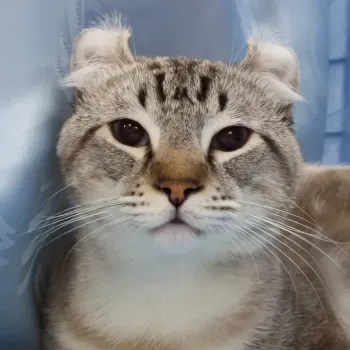
The American Curl Shorthair is a breed of cat recognised by FIFe (code ACS, category II). It originates from the United States, with its history rooted in California and a cat named Shulamith, who naturally had ears that curved backwards. This distinctive trait was stabilised and developed throughout the breed. Adult females typically weigh approximately 2.3-3.6 kg, whilst males weigh 3.2-4.5 kg. The breed is characterised by a harmonious build, soft silken coat, and distinctive ear curl, which develops during the kitten's first weeks of life.
The American Curl Shorthair comes from the United States, specifically originating in California. The breed traces its ancestry to a cat named Shulamith, whose ears naturally curved backwards. Her offspring inherited this trait, and the breed's further development produced both short-haired and semi-long-haired varieties.
The American Curl Shorthair displays an elongated, harmonious body with moderate musculature and a medium-strong bone structure. The legs are proportionate and of medium length, ending in rounded paws. The tail is long and elastic, broad at the base and tapering gradually. The head is shaped like a modified wedge with smooth contours and a gently rounded muzzle with a strong chin. The nose is straight and of medium length. The eyes are walnut-shaped and set slightly obliquely. The moderately large ears are open and broad at the base, curving backwards in a gentle arc with rounded, elastic tips.
The breed occurs in all colours and patterns. Solid, tabby, tortoiseshell, silver, smoke, white and colourpoint cats are all seen. Eye colour may vary independently of coat colour. In cats with Siamese-pattern colourpoint markings, blue eyes are required.
The American Curl Shorthair typically enjoys participating in family life, taking interest in its owner's activities and seeking opportunities for contact. It is affectionate, curious and generally gentle, though each cat has its own personality. It enjoys play, climbing and exploring new spaces. Many individuals retain a strong enthusiasm for play into adulthood. It usually communicates quietly, using soft chirping and purring sounds. The breed can integrate well with other cats and friendly dogs, particularly when animals are introduced gradually.
The short coat is soft, silken and resilient, lying close to the body. The minimal undercoat means it does not develop a dense, plush appearance. The hair on the tail is similar in length to that on the body. Grooming is straightforward, primarily involving gentle removal of loose hair with a soft brush or comb. The frequency of brushing can be adjusted according to the individual cat's shedding and needs. Grooming sessions should be introduced calmly so they become associated with pleasant contact with the owner.
The American Curl Shorthair is generally described as a breed in good overall health, without an established syndrome of diseases characteristic exclusively to it. This does not mean, however, that every individual will be free from hereditary conditions or problems common to cats generally. Regular veterinary check-ups remain an important part of care. Particular care must be taken with the ears: they should not be straightened, bent or pulled by the cartilage, as this can cause damage. Examination and any cleaning should be done gently, without forcing a change in ear shape. Should any concerns about a cat's health arise, consultation with a veterinary surgeon is essential.
| Organisation | Recognised | Breed code | Category |
|---|---|---|---|
| FIFe | yes | ACS | II |
- When does the characteristic ear curl become visible in kittens?
- The characteristic ear curl is not visible from birth. Kittens are initially born with straight ears, which begin to change shape within the first days of life. The final degree of curl typically becomes established around the fourth month of age.
- Does "curl" in the breed name refer to the coat?
- The name "curl" refers to the characteristic shape of the ears, not to a curled coat. The hair of this variety remains straight, smooth and silken.
- How should the ears of an American Curl Shorthair be handled?
- The ears should not be straightened, bent or pulled at the cartilage. Any cleaning should be done gently without forcing a change in ear shape, to avoid damaging the cartilage.
- Does this breed get along well with other animals?
- The American Curl Shorthair can integrate well with other cats and friendly dogs, particularly when animals are introduced gradually to one another.