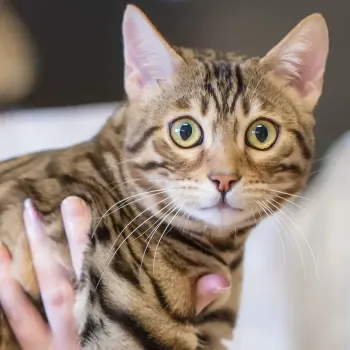
The Bengal is a cat breed recognised by FIFe and WCF. It originates from the United States and was developed by crossing a domestic cat with the Asian leopard cat (Prionailurus bengalensis). The Bengal is a medium to large-sized cat with a powerful, athletic build and distinctly defined musculature.
The Bengal originates from the United States. Her goal was to produce an animal combining the striking appearance of its wild ancestor with the friendly nature of a domestic cat.
The Bengal is a medium to large-sized cat. Adult females typically weigh 3.6-5.4 kg, whilst males weigh 4.5-6.8 kg. The body is powerful and athletic with distinctly defined musculature. The torso is long and strong, with the hindquarters slightly higher than the shoulders and the hind limbs marginally longer than the front legs. The paws are large and rounded. The tail, of medium length, is thick and tapers to a rounded tip. The head is broad and wedge-shaped with gently rounded contours. It is distinguished by prominent cheekbones, a broad nose, and a full muzzle with distinct whisker pads. The ears are small to medium-sized, broad at the base, with rounded tips. The eyes are large, oval, widely set, and slightly slanted, giving the cat an alert and characteristic appearance.
The Bengal is characterised by two distinct types of pattern: spotted, which includes rosettes, and marbled, which features irregular, flowing stripes and patches. Rosettes have a darker outline with a lighter centre. Clear contrast between pattern and ground colour is important. Recognised coat colours include brown, silver, and snow varieties in seal sepia, seal mink, and seal lynx point, including combinations with silver. The belly always displays spotting.
The Bengal is energetic, curious, and intelligent. It enjoys exploring its environment, climbing, and engaging in play that mimics hunting behaviour. It requires daily activity and mentally stimulating pursuits. Tall scratching posts, shelves, tunnels, and interactive toys allow it to utilise its natural agility. Bengals often form strong bonds with their owners and take interest in their daily activities. They enjoy participating in household life, though they typically choose their own moments for affection. Individual cats vary in temperament—some are highly outgoing whilst others require more time to build trust. This is a breed for people who enjoy active interaction with their cat and have time for shared play.
The Bengal's coat is short, dense, and exceptionally soft, lying close to the body and accentuating the musculature and contrast of the coat pattern. Some cats display a glitter effect—a subtle sheen that makes the fur appear dusted with shimmering reflections in light. Grooming is relatively straightforward, typically requiring gentle brushing once weekly to remove loose hair and maintain good coat condition. The short coat does not, however, mean an absence of shedding.
Several hereditary health conditions have been documented in Bengals. Progressive retinal atrophy (PRA-b) leads to gradual vision deterioration and eventually blindness. DNA testing is available to identify both affected cats and asymptomatic carriers. Pyruvate kinase deficiency (PKDef) can cause anaemia, and genetic testing is available for this condition as well. The breed has also been described as prone to hypertrophic cardiomyopathy (HCM), a disease that causes thickening of the heart muscle walls, diagnosed via echocardiogram. A normal result for PRA-b and PKDef testing does not exclude HCM, as the tests detect different conditions. Any health concerns should be discussed with a veterinary surgeon.
| Organisation | Recognised | Breed code | Category |
|---|---|---|---|
| FIFe | yes | BEN | III |
| WCF | yes | BEN | — |
- Do all Bengals have rosettes?
- No. Some cats of this breed have individual spots or a marbled pattern instead of rosettes.
- Can Bengals live with other animals?
- With proper introduction, they can adapt well to living alongside other animals.
- What is the glitter effect in Bengals?
- The glitter effect is a subtle sheen of the coat that makes it appear dusted with shimmering reflections in light. Not every Bengal possesses this trait.
- How often does a Bengal need brushing?
- Gentle brushing once weekly is usually sufficient to remove loose hair and maintain good coat condition.