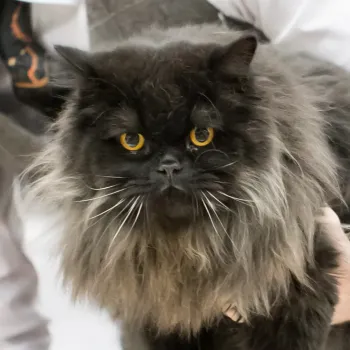
The British Longhair is a cat breed recognised by FIFe (BLH). It originates from Great Britain and is closely related to the British Shorthair. The longer coat emerged in the British cat population through historical crossings with Persians, and breeders subsequently developed these longhaired cats as a distinct breed. These are medium to large-sized cats, with males weighing approximately 4.5-7.3 kg and females 3.6-5 kg. The substantial build should result from strong muscle and bone structure rather than excess weight.
The British Longhair evolved from the British Shorthair population in Great Britain. The longer coat in its ancestors arose through early crosses with Persians, which introduced this genetic trait. Over time, cats with this type of coat were developed as a separate breed.
The build is compact, sturdy and well muscled, with a broad chest, strong shoulders and a solid back. The legs are short and sturdy, with round paws. The tail is short and thick with a slightly rounded tip. The head is round and massive, featuring a broad skull and a strong chin, set on a short, strong neck. The nose is short, wide and straight, with a gentle break at its base. Small ears with rounded tips are set wide apart. Large, round eyes give the face a gentle expression and may be copper, deep orange, blue or green depending on coat colour.
Many coat colour variations are permitted. Solid colours include white, black, blue, chocolate, lilac, red, cream, cinnamon and fawn. There are also tortoiseshell, tabby, smoke, silver and golden variants, as well as combinations with white. Colourpoint varieties with darker markings on the face, ears, legs and tail are also acceptable.
The British Longhair is typically calm, gentle and devoted to its family members. It enjoys being near them, though it often prefers to rest beside its owner rather than sit on laps, and many cats of this breed do not enjoy being held. It can find its own entertainment but still needs daily interaction and play. It is usually not particularly vocal or constantly active, though it does have bursts of energetic chasing. It can coexist well with children and dogs provided interactions are quiet and respect its boundaries.
Despite its name, the coat is semi-long with a double structure and undercoat that stands away from the body. The texture should be springy rather than woolly. A well-developed ruff surrounds the neck, whilst the abundantly furred tail emphasises the cat's fluffy appearance. The coat requires regular brushing, and daily, gentle grooming helps prevent matting and tangles. During shedding periods, thorough removal of loose undercoat is particularly important. It is advisable to accustom the cat to brushing from the youngest months.
British Longhairs should be monitored for the risk of hereditary polycystic kidney disease associated with the PKD1 gene variant. This condition causes cysts to develop in the kidneys and can lead to deterioration of kidney function. A DNA test is available to detect this genetic variant. Another important concern is hypertrophic cardiomyopathy (HCM), a disease involving thickening of the heart muscle. Echocardiography is used to assess the heart, although a normal result from a single examination does not rule out development of the disease at a later age. The breed's quieter lifestyle and tendency towards eating can predispose to excess weight, so portion control, limiting treats and regular play are important. Any health concerns should be discussed with a veterinary surgeon.
| Organisation | Recognised | Breed code | Category |
|---|---|---|---|
| FIFe | yes | BLH | III |
- How much does an adult British Longhair weigh?
- Males weigh approximately 4.5–7.3 kg and females 3.6–5 kg. The substantial build should result from strong muscle and bone structure rather than excess weight.
- What is the actual coat length of this breed?
- The coat is semi-long, despite the breed name suggesting a fully long-haired cat. It has a double structure, undercoat and springy texture.
- Does the British Longhair enjoy sitting on laps?
- It typically prefers to rest beside its owner rather than being held on the lap. Many cats of this breed do not enjoy being picked up.
- Can I have this cat if I have a child or dog?
- The British Longhair can coexist well with children and dogs provided interactions are quiet and respect its boundaries.
- When do kittens reach their full adult coat colour?
- The coat colour of kittens may take longer to reach its full development and intensity.