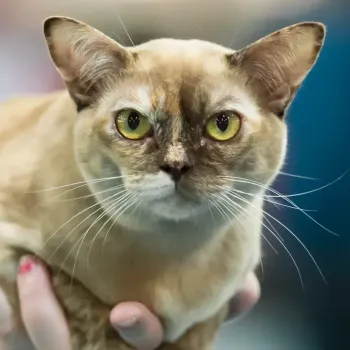
The Burmese is a cat breed recognised by FIFe (BUR, category III). Its roots reach back to Burma, present-day Myanmar, but the modern form developed in the United States from the 1930s onwards. It is a medium-sized cat with a compact, well-muscled build and short, silky coat. The breed is characterised by a strong attachment to people and a need for their companionship.
The Burmese has its origins in Burma, present-day Myanmar. The modern breed began in the United States in 1930, when Joseph Thompson brought a female cat named Wong Mau to America—a cat that played a crucial role in the breed's development. Burmese cats later travelled to the United Kingdom, where a separate European type developed. The two types differ in appearance: the European type has more moderate proportions and a short wedge-shaped head, whilst the American type is more compact and rounded.
The Burmese is a medium-sized breed. Adult females typically weigh approximately 2.7-4.1 kg, whilst males weigh around 5-6.4 kg. Strong musculature often makes the cat appear heavier than its appearance might suggest. The silhouette is compact, elegant and well-muscled. The body is of medium length, the chest is strong, and the back is straight. The legs are relatively slender and end in small, oval paws. The tail is of medium length and tapers to a rounded tip.
The head is shaped like a short wedge, broad at the cheekbones, with a slightly rounded upper part of the skull. In profile, a distinct break is visible at the base of the nose. The ears are medium-sized, set wide apart and slightly tilted forward. The eyes are large, with a more straight upper line and a rounded lower line, in shades ranging from yellow to amber, with a golden-yellow colour being preferred.
Acceptable colours include sable, blue, chocolate, lilac, red and cream. Additionally, four tortoiseshell variations are recognised: sable, blue, chocolate and lilac. The underside of the body is lighter than the back and legs, and transitions between colours should be gradual. The muzzle and ears may be slightly darker. Adult cats should not display obvious tabby markings.
Kittens may have a lighter coat than adult cats. As they mature, the colour becomes fuller, and faint tabby traces may fade away.
The Burmese is typically outgoing, inquisitive and deeply attached to people. It likes to follow its owner, observe their activities and seek opportunities for shared time together. After play, it enjoys resting close to its person, often on their lap.
The breed is intelligent and playful, so it requires daily activities that engage both body and mind. Its strong need for companionship means it may not cope well with extended periods of solitude. It generally gets on well with other animals if introductions are handled calmly. When interacting with children, gentleness and respect for its need for rest are important.
The Burmese coat is very short, delicate and silky, with a distinct sheen. It lies close to the body, emphasising the musculature. The undercoat is almost absent, so the fur does not have a fluffy structure. Grooming is typically straightforward. Gentle brushing removes loose hair and keeps the coat smooth. Regular bathing is usually not necessary. Many Burmese cats willingly accept grooming procedures, treating them as another opportunity for closeness with their owner.
One of the confirmed hereditary diseases in this breed is Burmese hypokalemia, associated with periodic reduction in blood potassium levels. It causes muscle weakness, which may impair walking and proper head carriage. A DNA test is available that detects the genetic variant associated with the disease. The test can also identify carrier status; a cat with one copy of this variant does not develop the hereditary form of hypokalemia but may pass it to offspring.
Burmese cats have also been reported to show increased susceptibility to diabetes in some populations. In daily care, it is worth paying particular attention to maintaining proper body weight, especially in older cats, as excess weight further increases the risk of this disease. Any health concerns should be discussed with a veterinary surgeon.
| Organisation | Recognised | Breed code | Category |
|---|---|---|---|
| FIFe | yes | BUR | III |
- What are the differences between the European and American types?
- The European type has more moderate proportions and a short wedge-shaped head, whilst the American type is more compact and rounded.
- Are Burmese kittens born with a lighter coat?
- Yes, Burmese kittens may have a lighter coat than adult cats. As they mature, the colour becomes fuller, and faint tabby traces may fade away.
- How much daily attention does a Burmese need?
- It requires daily activities that engage both body and mind. Its strong need for companionship means it may not cope well with extended periods of solitude.
- How demanding is coat care?
- Coat care is typically straightforward and consists of gentle brushing, which removes loose hair and keeps the coat smooth. Regular bathing is usually not necessary.