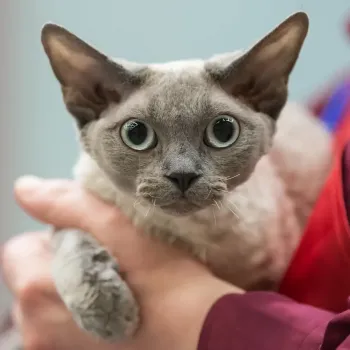
Devon Rex is a breed of cat recognised by FIFe and WCF. It originates from Great Britain, specifically from the county of Devon, where a male cat named Kirlee was born in 1959 and displayed the breed's characteristic wavy coat caused by a unique genetic mutation. This is a medium-sized cat with a slender yet compact and muscular build, distinguished by large ears, prominent eyes and full cheeks. Despite its delicate appearance, the Devon Rex is agile, nimble and capable of surprising strength during jumps.
Devon Rex originates from Great Britain, specifically from the county of Devon in south-west England. The breed traces back to Kirlee, a male cat born in 1959 who was distinguished by his wavy coat. Initially, it was believed he was related to the Cornish Rex; however, research revealed that the characteristic appearance of his coat was caused by a different genetic mutation.
Devon Rex is a medium-sized cat with a slender yet compact and muscular build. Adult females typically weigh around 2.3-3.2 kg, whilst males weigh approximately 3.2-4.1 kg. The body is of medium length with a broad chest and a long, slender neck. The legs are long and delicate, ending in small, oval paws. The tail is long, thin and tapers gradually towards the tip.
The head is shaped like a short, broad wedge with distinctly prominent cheekbones, full cheeks and a short muzzle. The nose is short, the chin strong, and the rounded forehead transitions into a flatter part of the skull. Most striking are the very large ears, broad at the base, set low and ending in rounded tips. The large, oval eyes are set wide apart and angled slightly towards the outer edges of the ears, giving the cat an alert and inquisitive expression.
Devon Rex appears in all colours and coat patterns. Acceptable colours include solid, tabby, tortoiseshell, smoke, silver and golden varieties. Cats with darker markings on the muzzle, ears, legs and tail are also permitted, including colourpoint patterns. The coat may contain any amount of white, ranging from small patches to extensive white areas. Among the colours found in this breed are black, blue, chocolate, lilac, cinnamon, fawn, red and cream.
Devon Rex is sociable, inquisitive and strongly attached to its household members. It enjoys being close to people, settling on laps and accompanying them in daily activities. This is an intelligent cat that likes to explore its surroundings and participate in household life. It readily climbs to high places, investigates new objects and enjoys toys requiring active engagement. Some Devon Rexes learn to fetch and perform simple tricks.
It typically thrives well in families with children and in the company of other cats and friendly dogs, though it requires careful introduction to other animals and respect for its boundaries. It may struggle with long periods of solitude, particularly when lacking in occupation and contact with its household members.
The Devon Rex's coat is very short, delicate and soft, arranged in waves or small curls. Grooming requires gentle handling of the coat, as vigorous brushing may damage it. Usually, gentle smoothing with the palm or wiping with a soft cloth is sufficient. It is worth regularly checking the cleanliness of the ears and the length of the claws.
Devon Rexes may develop Congenital Myasthenic Syndrome (CMS), a hereditary disorder causing muscle weakness and rapid fatigue. Symptoms can emerge in kittens, and DNA testing allows detection of the mutation responsible for the disease and identification of carrier status. The breed also shows a predisposition to patellar luxation.
Some individuals may experience skin problems such as seborrhoea or inflammation associated with excessive proliferation of Malassezia yeast, which may manifest as greasy, inflamed skin, unpleasant odour or itching. In cats with completely white coats, particularly those with blue eyes, congenital deafness is possible. Any health concerns require consultation with a veterinary surgeon.
| Organisation | Recognised | Breed code | Category |
|---|---|---|---|
| FIFe | yes | DRX | IV |
| WCF | yes | DRX | — |
- Where does the Devon Rex originate and what is its history?
- The breed comes from Great Britain, specifically from the county of Devon. It traces back to Kirlee, a male cat born in 1959 who was distinguished by his wavy coat caused by a unique genetic mutation.
- What is the weight of a Devon Rex?
- Adult females typically weigh around 2.3–3.2 kg, whilst males weigh approximately 3.2–4.1 kg. It is a medium-sized cat with a slender yet muscular build.
- In what coat colours does the Devon Rex appear?
- The breed permits all colours and coat patterns, including solid, tabby, tortoiseshell, smoke, silver, golden and colourpoint varieties, with any amount of white.
- Does the Devon Rex thrive well in a family home?
- It typically does well in families with children and in the company of other cats or friendly dogs. However, it struggles with prolonged solitude and requires occupation and regular contact with its household members.
- What health concerns may affect the Devon Rex?
- The breed may develop Congenital Myasthenic Syndrome, show predisposition to patellar luxation, experience skin problems, and cats with white coats may have congenital deafness. Any health concerns require consultation with a veterinary surgeon.