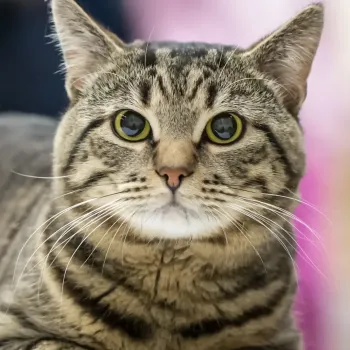
The European is a breed recognised by FIFe. It descends from the natural population of domestic cats across Europe, where the Nordic countries played an important role in shaping the breed during the early twentieth century. This is a medium to large-sized cat that retains the natural type of the European cat, with characteristic strong build and sprightly movement. Adult females typically weigh approximately 3.5-5.5 kg, whilst males weigh around 4.5-7 kg. The short, dense and glossy coat emphasises the breed's natural silhouette.
The European descends from the natural population of domestic cats across Europe. The Nordic countries played an important role in developing the breed, where during the early twentieth century efforts began to preserve the local type of short-haired cat. The breed was established to maintain the natural type of the European cat without the introduction of other breeds. Its characteristic appearance is based on harmonious proportions, strong build and natural agility.
The European has a strong, well-muscled body and a well-developed chest, whilst maintaining agility and sprightly movement. The powerful legs are of medium length and end in rounded paws. The tail is of medium length, thicker at the base and tapers gradually to a rounded tip.
The head is fairly large and rounded, somewhat longer than it is wide. The cheeks are well developed. The nose is straight and of medium length. The ears have slightly rounded tips and are set wide apart. The eyes are rounded, set wide apart and slightly slanted; their colour depends upon the coat colour.
Acceptable colours include white, black, blue, red and cream, as well as tortoiseshell. Smoke varieties and tabby patterns are also permitted: classic, mackerel and spotted, including silver. Solid and tortoiseshell colours may be combined with white in bicolour, harlequin or van patterns.
The European typically combines curiosity and a desire to play with a balanced temperament. It is observant, intelligent and interested in its surroundings. It can occupy itself independently with a toy or by watching what happens around it. It enjoys climbing, exploring and play that mimics hunting. Individual cats vary in their openness and need for contact.
It can adapt well to an active household, provided it has a quiet resting place and interaction that respects its boundaries. It can be a good companion for a family with children, other cats and friendly dogs, though introducing animals should be done gradually. Daily play and an enriched environment help satisfy its need for activity.
The coat is short, dense, springy and glossy. Brushing once a week usually suffices to remove loose hair. During periods of heavier shedding, grooming frequency can be increased. The short coat means that daily grooming is relatively straightforward.
The European is generally described as a breed in good health, though this does not confer immunity to illness. Like other cats, it can experience dental problems, excess weight and age-related conditions. It is worth monitoring body weight and adjusting food portions to the cat's activity level, as excess weight increases the risk of metabolic problems and puts strain on the joints. Regular checks of the oral cavity are also important, as the accumulation of plaque and tartar can lead to gum inflammation and periodontal disease. Regular veterinary examinations help to identify changes in the cat's condition early.
| Organisation | Recognised | Breed code | Category |
|---|---|---|---|
| FIFe | yes | EUR | III |
- How does the European compare to ordinary domestic cats?
- The pedigree European can look very similar to an ordinary domestic cat. However, it is a distinct, recognised breed with its own standard, and appearance alone resembling a European is not sufficient to confirm breed status.
- What are this cat's activity and play requirements?
- It enjoys climbing, exploring and play that mimics hunting behaviour. Its strong hunting instinct can be satisfied indoors through wand toys, food-seeking games and access to observation points.
- Can a European live with other animals?
- It can form good relationships with other cats and friendly dogs, though introducing animals should be gradual and take into account the individual cat's characteristics.
- What do adult cats of this breed weigh?
- Adult females typically weigh approximately 3.5–5.5 kg, whilst males weigh around 4.5–7 kg, though larger individuals do occur.
- How often does a European need grooming?
- Brushing once a week usually suffices. During periods of heavier shedding, grooming frequency can be increased.