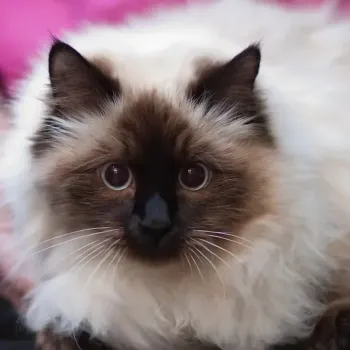
The Neva Masquerade is a cat breed recognised by FIFe. It originates from Russia and is closely related to the Siberian cat. The breed is distinguished by intensely blue eyes and a characteristic colourpoint pattern, in which a light body contrasts with darker markings on the face, ears, limbs and tail. The name refers to the Neva river in Saint Petersburg and to the mask-like marking on the cat's face. It is a medium to large-sized cat with a powerful, well-muscled build.
The Neva Masquerade originates from Russia and is closely related to the Siberian cat. Adult females typically weigh around 4-6 kg, whilst males weigh around 6-8 kg, though individual sizes may vary. Like the Siberian cat, it develops slowly and reaches full physical maturity only at around 4-5 years of age.
The body is powerful, well-muscled and supported by a solid skeletal frame. A broad chest, strong neck and proportional torso create an outline approaching a rectangle. The limbs are of medium height and the paws are large and round, with tufts of hair between the toes. The tail is of medium length, thick and evenly covered with dense fur.
The head is massive, gently rounded and slightly longer than it is wide. The nose remains broad, with a gentle dip in profile. The ears are of medium size, set wide apart and slightly tilted forwards. Large, slightly oval eyes are intensely blue in colour.
The characteristic colourpoint pattern features a light body contrasting with darker markings on the face, ears, limbs and tail. Permitted colours for the markings include seal (dark brown), blue, red and cream, as well as tortoiseshell variations in seal and blue. Markings may also be tabby, smoke, silver and golden, along with their respective combinations. Any amount of white is permitted. Chocolate, lilac, cinnamon and fawn colours are excluded.
The Neva Masquerade is typically affectionate, sociable and interested in the lives of its household members. It needs the attention of its owner, readily remains close by and participates in daily activities. Towards strangers it may maintain greater distance and require time before accepting petting.
It balances quieter moments with energetic play. It is intelligent, curious and despite its substantial build, remarkably agile. It enjoys climbing and observing its surroundings from height. It usually gets on well with other cats, friendly dogs and children who can handle the animal calmly. Introduction should progress gradually, allowing the cat an opportunity to withdraw to its own resting place.
The Neva Masquerade has semi-long, very dense fur. An abundant undercoat gives it volume, whilst the guard hairs are somewhat coarser and limit moisture penetration. Winter coat forms a distinct ruff, a frill on the chest and "britches" on the hind legs. In summer the coat is considerably shorter and less full.
Regular brushing helps remove loose undercoat and prevent matting. The coat requires particular attention during seasonal shedding. It is worthwhile to accustom the cat to grooming from an early age, so that it tolerates combing of denser areas of fur calmly.
In Siberian cats, to which the Neva Masquerade is closely related, hypertrophic cardiomyopathy (HCM) has been documented, which causes thickening of the heart muscle walls. It may progress without visible symptoms for some time. Echocardiographic examination is used to assess the heart. A normal result from a single check does not guarantee that the disease will not develop later.
An important hereditary disorder is pyruvate kinase deficiency (PKDef), which may lead to anaemia. An available DNA test allows detection of the mutation and carrier status. Polycystic kidney disease (PKD) has been identified in certain Siberian lines. The scope of health screening should be determined with a veterinary surgeon, taking into account the cat's age, health status and family history.
| Organisation | Recognised | Breed code | Category |
|---|---|---|---|
| FIFe | yes | NEM | II |
- Is the Neva Masquerade a hypoallergenic breed?
- The breed is sometimes recommended for people with cat allergies, but it cannot be guaranteed that it will not cause an allergic reaction. The amount of allergens produced and an individual's reaction may vary, so the cat's breed alone does not determine whether an allergic person will tolerate it.
- How quickly does a Neva Masquerade mature?
- Like the Siberian cat, it develops slowly and reaches full physical maturity only at around 4–5 years of age.
- What are the main differences between a Neva Masquerade and a Siberian cat?
- Both cats share a common body type and coat structure. The most visible differences concern the colourpoint pattern and blue eye colour, which are characteristic of the Neva Masquerade.
- How much space does a Neva Masquerade need?
- It is agile despite its substantial build, enjoys climbing and observing from height, so sturdy cat trees with platforms and safe shelves work well for the breed.
- How does a Neva Masquerade get on with other pets?
- It usually gets on well with other cats, friendly dogs and children who can handle the animal calmly.