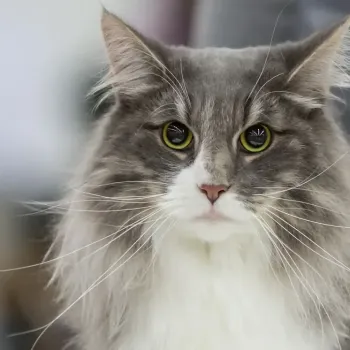
The Norwegian Forest Cat is a breed recognised by FIFe (code NFO). It is a natural breed originating from Norway, where it developed over many generations in a harsh Scandinavian climate. It belongs to the large domestic cat breeds, with adult females weighing approximately 3.6-5.4 kg and males approximately 5.4-8.2 kg. These cats reach full maturity only around 4-5 years of age. A robust build, dense undercoat and moisture-resistant coat were essential for surviving cold winters in the forest.
The Norwegian Forest Cat originates from Norway and is a natural breed whose appearance developed over many generations in a harsh Scandinavian climate. In its homeland, it is known as Norsk Skogkatt, meaning Norwegian forest cat. A strong body, dense undercoat and coat that repels moisture helped these cats survive cold winters. The breed is classified in FIFe category II.
The body is elongated, powerful and well-muscled, with a solid bone structure. Strong legs hold the body high above the ground, with hind legs longer than the front legs. The paws are large and round, and a long, fluffy tail completes the body's proportions.
The head is shaped like an equilateral triangle. The forehead is slightly rounded, the chin strong, and the nose profile is long and straight, without a pronounced break. Large, high-set ears are broad at the base and adorned with tufts and long hairs growing from the interior. The eyes are large, oval and slightly slanted, giving the face an alert expression. They may be any colour, regardless of coat colour.
Permitted colours include black, blue, red, cream and white, as well as tabby, tortoiseshell, smoke, silver and amber varieties. Colours may occur with any amount of white, from small markings to extensive white areas.
Excluded colours are chocolate, lilac, cinnamon and fawn, as well as pointed patterns with darker markings on the face, ears, limbs and tail.
A distinctive feature is the amber colour, whose appearance changes as the cat matures. A lighter variation of this colour is also seen.
The Norwegian Forest Cat combines a friendly disposition with independence. It becomes attached to its household members and enjoys being in their company, but chooses when it wants affection. Not every individual of this breed enjoys resting on laps—some prefer to settle beside their owner and quietly observe their activities.
It is curious, intelligent and keen to play. It particularly enjoys climbing and readily uses tall scratching posts, shelves and platforms. Despite its large size, it remains agile and needs daily opportunities for movement, stalking toys and exploring its surroundings.
It typically adapts well to families with children who know how to handle the animal gently. It can also live harmoniously with other cats and friendly dogs. Towards strangers, it is initially cautious. A secure balcony or outdoor enclosure can provide additional space for observation and activity.
The Norwegian Forest Cat has a semi-long, double-layered coat. A soft, woolly undercoat retains warmth, whilst longer, coarser guard hairs prevent moisture penetration. In winter, the coat becomes particularly full, forming an impressive ruff around the neck, a distinct chest frill, and characteristic "knickers" on the hind legs. In summer, the coat is usually lighter and less abundant.
The coat requires regular brushing, typically once or twice weekly. During heavy shedding periods, more frequent brushing is beneficial, even daily. Removing loose undercoat helps prevent matting and reduces the amount of hair swallowed during grooming. Ingesting large amounts of loose hair can contribute to hairballs and digestive problems, so regular brushing is also important for gastrointestinal comfort.
One of the important hereditary diseases in this breed is glycogen storage disease type IV (GSD IV), which disrupts proper glycogen storage, leading to organ and muscle damage. It can cause kittens to die at birth or manifest after several months of apparently normal development. A DNA test is available to detect the mutation and carrier status.
Norwegian Forest Cats have also been reported to develop hypertrophic cardiomyopathy (HCM) and pyruvate kinase deficiency (PKDef), which can lead to anaemia. A genetic test is available for PKDef. Echocardiography is the primary tool for assessing the heart and detecting HCM; your veterinary surgeon will determine the frequency of checks needed.
Any suspicion of health problems requires consultation with a veterinary surgeon.
| Organisation | Recognised | Breed code | Category |
|---|---|---|---|
| FIFe | yes | NFO | II |
- What size is a Norwegian Forest Cat?
- Adult females weigh approximately 3.6–5.4 kg, whilst males weigh approximately 5.4–8.2 kg. The abundant coat further emphasises their size. They reach full maturity around 4–5 years of age.
- How often should the coat be brushed?
- Typically once or twice weekly, though during heavy shedding it is worth doing so more frequently, even daily. Regular brushing prevents matting and supports gastrointestinal comfort.
- Is this breed suitable for families with children?
- It typically adapts well to families when children know how to handle the animal gently. They can also live harmoniously with other cats and friendly dogs.
- What equipment is important for a Norwegian Forest Cat?
- The breed particularly enjoys climbing, so sturdy, tall scratching posts and stable climbing areas appropriate for their weight are worthwhile. Norwegian Forest Cats can skilfully descend from trees head-first.
- What genetic diseases may affect this breed?
- An important hereditary disease is glycogen storage disease type IV (GSD IV). Hypertrophic cardiomyopathy (HCM) and pyruvate kinase deficiency (PKDef) have also been reported. Genetic tests are available for some of these conditions.