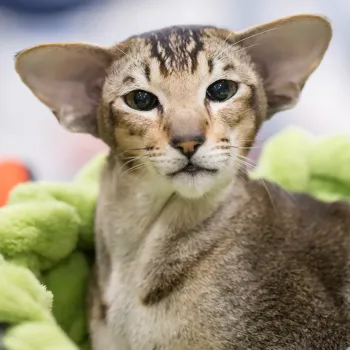
The Oriental Shorthair is a cat breed recognised by FIFe (code OSH, category IV). The breed stands out for its energetic temperament and strong need for human companionship and interaction.
Breeding work utilised Siamese cats and crosses with other shorthaired cats, aimed at preserving the elegant Siamese form whilst achieving a diverse range of coat colours and patterns. The breed was subsequently developed further in the United States.
The Oriental Shorthair is a medium-sized cat. Adult individuals typically weigh approximately 3.6-6.4 kg. The silhouette is long, slender and supple, with well-developed musculature. The neck is long and delicate, whilst the legs are set high and slender, lending the breed an elegant appearance. The paws are small and oval, whilst the tail is notably long, thin and tapers gradually towards its tip. The head is wedge-shaped with straight lines that widen from the nose towards the ears. The nose is long and straight, flowing smoothly from the brow line. Large, pointed ears, characteristic of the breed, are broad at the base and form a continuation of the head's outline. The eyes are almond-shaped and positioned slightly obliquely, typically a vivid green. In white individuals, blue eyes or heterochromia—one green eye and one blue eye—are permissible.
The breed is distinguished by considerable diversity in coat colour and pattern. Solid colours include black, blue, chocolate, lilac, cinnamon, fawn, red, cream and white. The breed also includes tortoiseshell, tabby, smoke, shaded and white-marked variants. In solid-colour varieties, the colour should be even, without unwanted tabby markings or shading.
The Oriental Shorthair is typically energetic, inquisitive and highly interested in human company. It readily participates in household activities and expresses its needs clearly and often vocally, proving notably talkative. The breed requires considerable attention and close contact with its people. The playfulness and activity characteristic of kittens are retained by many individuals throughout their lives. Extended solitude is poorly tolerated. When introduced calmly, the breed generally coexists well with other cats and dogs, though individual temperaments vary. A strong need for human contact is an important hallmark of the breed.
The coat is exceptionally short, delicate, silky and glossy, lying closely to the body and emphasising the slender lines. The undercoat is almost absent. Grooming is typically undemanding. Gentle brushing once weekly removes loose hair and maintains coat condition. Many Oriental Shorthairs enjoy this activity as an opportunity for contact with their owner.
Oriental Shorthairs carry a hereditary form of progressive retinal atrophy known as PRA-rdAc. The condition causes gradual vision deterioration and may lead to blindness. A DNA test is available (CEP290 marker) to identify the gene variant associated with the disease. The test also identifies carriers—cats with one copy of the variant that do not develop the condition but may pass it to offspring. The breed is also documented to experience familial amyloidosis, associated with abnormal protein accumulation in organs including the liver, which can impair organ function. The presence of these conditions in the breed does not mean every cat will develop them. Any health concerns should be discussed with a veterinary surgeon.
| Organisation | Recognised | Breed code | Category |
|---|---|---|---|
| FIFe | yes | OSH | IV |
- What is the typical weight of an adult Oriental Shorthair?
- Adult individuals typically weigh approximately 3.6–6.4 kg, depending on the individual cat's size and build.
- Do Oriental Shorthairs tolerate being alone?
- No. They tolerate extended solitude poorly and require considerable attention and close contact with their people.
- Can Oriental Shorthairs live with other animals?
- When introduced calmly, they generally coexist well with other cats and dogs, though individual temperaments vary.
- How much grooming does this breed require?
- Gentle brushing once weekly is sufficient. Due to the exceptionally short coat lacking a fluffy undercoat, grooming is not time-consuming.
- What genetic conditions affect this breed?
- A DNA test is available to identify the gene variant associated with progressive retinal atrophy (PRA-rdAc). The breed is also documented to experience familial amyloidosis. A veterinary surgeon can help assess individual risk.