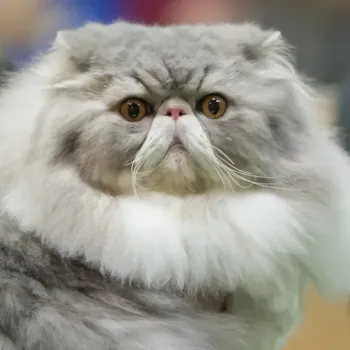
The Persian is a cat breed recognised by FIFe. Its traditional origins trace back to Persia, the region now known as Iran, though the breed's history was also shaped by long-haired cats brought to Europe from Turkey. The modern Persian differs significantly from its ancestors, with its distinctive appearance having developed over many generations of selective breeding. Adult females typically weigh approximately 3-5 kg, whilst males weigh 5-7 kg. The breed is distinguished by its long, dense and silky coat, coupled with a characteristically calm and gentle temperament.
The history of the Persian cat traditionally extends back to Persia, now known as Iran. The breed also developed from long-haired cats brought to Europe from Turkish territories. The modern Persian differs considerably from its historical ancestors, with its characteristic appearance having been shaped over many generations of breeding. Persian cats were already being exhibited at the Crystal Palace show in London in 1871.
The Persian has a compact, well-muscled frame with a broad chest and powerful shoulders. The head is massive and rounded, with a broad skull, full cheeks and a strong chin. The small ears with rounded tips are set low and wide. Large, round eyes give the face a gentle expression. The nose is short and broad, with a distinct break in profile between the eyes. The nostrils should be well open, allowing free breathing. The short, thick legs end in large, round paws. The neck is short and strong, and the tail is proportional to the body, short and fluffy.
Persians come in many colour varieties. Solid colours include white, black, blue, chocolate, lilac, red and cream. There are also tortoiseshell, tabby, smoke, silver and golden variations, as well as these colours combined with white. Colourpoint patterns are also acceptable, with darker markings on the face, ears, legs and tail. Eye colour varies depending on the coat colour.
The Persian cat typically has a calm and gentle temperament. It enjoys the closeness of its owners, readily resting beside people, accepting affection and observing household life from a comfortable spot. It generally does not demand attention in a noisy manner. It enjoys play, though it usually prefers shorter, quieter activities. It may do well in the company of children and other animals if they treat it gently and respect its need for rest. Individual cats vary in temperament. The Persian is typically an indoor cat that values a peaceful environment and a predictable daily routine. Many cats of this breed prefer a comfortable sofa or low bed, though they do require daily play and the opportunity to express natural feline behaviours.
The long, dense and delicate coat requires daily combing, as matting occurs easily. Regular grooming also removes loose hairs that the cat might swallow during self-grooming. Kittens should be accustomed to combing gently and calmly. During warm weather, the Persian should be given access to cooler rooms, as the profuse coat and shortened muzzle can make it difficult to tolerate high temperatures.
Persian cats may develop hereditary polycystic kidney disease, associated with a variant of the PKD1 gene. Cysts develop in the kidneys, which may gradually impair their function. A DNA test is available to detect this genetic variant. The breed is also known to develop hereditary progressive retinal atrophy (PRA-pd), which leads to vision loss. Genetic testing is available for this condition as well. These diseases do not affect every Persian cat. The shortened muzzle structure may predispose the breed to breathing difficulties and ocular and dermatological problems. The area around the eyes requires regular monitoring and gentle cleaning. Any signs such as persistent tearing, redness or noisy breathing should be discussed with a veterinary surgeon.
| Organisation | Recognised | Breed code | Category |
|---|---|---|---|
| FIFe | yes | PER | I |
- What is the typical size and weight of a Persian cat?
- Adult females typically weigh approximately 3–5 kg, whilst males weigh 5–7 kg. Correct body weight also depends on the individual size and build of the cat.
- How often should a Persian be groomed?
- The coat requires daily combing to prevent matting and to remove loose hairs that the cat might swallow during grooming.
- Can a Persian live in a flat?
- The Persian is typically an indoor cat that values a peaceful environment and a predictable daily routine, though it does need daily play and the opportunity to express natural feline behaviours.
- What are the main health concerns in Persians?
- Persians may develop hereditary kidney and eye diseases, including polycystic kidney disease (PKD1) and progressive retinal atrophy (PRA-pd). DNA tests are available for both. The shortened muzzle can predispose the breed to breathing difficulties and ocular problems.
- How many colours do Persians come in?
- Persians are available in many colour varieties, ranging from solids such as white, black, blue, chocolate, lilac, red and cream, through tortoiseshell, tabby, smoke, silver and golden, to colourpoint patterns.