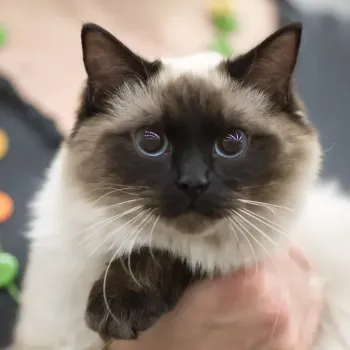
Ragdoll is a cat breed recognised by FIFe. It originated in Riverside, California, in the United States during the 1960s, developed through selective breeding by Ann Baker, who focused on longhaired domestic cats with striking appearance and gentle temperament. The Ragdoll is a large, solidly built cat combining impressive size with a delicate and affectionate nature.
The breed was established in Riverside, California in the 1960s. Its creator was breeder Ann Baker, who selectively bred longhaired domestic cats, paying particular attention to their appearance and gentle temperament. One of the foundation females was a white cat named Josephine. In the further development of the breed and its popularisation, Denny and Laura Dayton also played a significant role.
Ragdoll is a large, solidly built cat with a long, muscular body and medium to strong bone structure. The chest is broad and well developed, whilst the hindquarters are powerfully muscled and substantial. The head is medium-sized, broad and modified wedge-shaped in form. The forehead is gently rounded, flowing smoothly into a flat plane between the ears. The nose is straight with a delicate curve in the upper third. The cheeks are well developed, the muzzle broad, rounded and medium length, with a distinctly pronounced chin. The ears are medium-sized, broad at the base with rounded tips, set wide on the skull and tilted slightly forward. The eyes are large, oval and intensely blue. The neck is short and strong. The limbs are medium length with strong bone structure; the hind legs are slightly higher than the front legs. The paws are large, round and compact, with tufts of hair between the toes. The tail is long, preferably reaching to the shoulder, moderately wide at the base and gently tapered towards the tip.
Ragdoll comes in three pattern variations. Colourpoint displays a lighter body with distinctly marked points on the ears, face, limbs and tail. Mitted features the same point markings as colourpoint, with white chin and a continuous white stripe running from the chin pad down the underside of the body to the base of the tail. White mittens on the front paws extend to a maximum of the wrist pads, whilst on the hind paws the white reaches at least to the heel and a maximum of halfway up the thigh. Bicolour shows distinct points on the ears, face and tail, with a white inverted V marking on the face encompassing the nose mirror, white chin and white belly. Entirely white limbs are preferred. Ragdoll occurs in the colours seal, blue, chocolate, lilac, red and cream. All three patterns may display tabby variants and tortoiseshell variants.
Ragdoll is a cat with a gentle and calm temperament. It typically has a well-balanced nature and moderate activity level, though young cats can be highly energetic. The breed is sociable, enjoying the company of people and participating actively in the daily life of household members. It forms a strong attachment to its owner, often following them around the home, greeting them upon return and seeking closeness. The cat readily initiates contact and accepts affection. Ragdoll can learn simple behaviours such as coming when called or retrieving objects. It enjoys play with its owner, though it is not particularly vocal. Generally, Ragdoll shows tolerance towards other animals and can coexist well with cats and dogs when properly introduced.
Ragdoll has a semi-long, dense, soft and silky coat that lies close to the body. Coat length varies depending on body area: the hair is short on the face, lengthening from the top of the head through the shoulders towards the back. The longest hair occurs around the neck, where it forms a distinctive ruff. On the sides of the body, belly and hindquarters, the hair is medium to long in length, whilst on the front limbs it is short to medium length. The tail is abundantly coated and plumed. The coat requires regular combing, as despite its silky texture it can mat if grooming is neglected. Ragdoll sheds throughout the year, requiring more frequent grooming during periods of heavy coat loss. Kittens are born white, with colour points beginning to appear several days after birth and developing progressively with age. Ragdoll reaches full adult size and weight only around the fourth year of life.
A genetic variant R820W in the MYBPC3 gene has been identified in Ragdoll, associated with increased risk of hypertrophic cardiomyopathy (HCM), a condition characterised by thickening of the heart muscle. Cats carrying two copies of this variant face a high risk of developing severe HCM, which may manifest at a young age. A DNA test detecting the R820W variant is available, indicating whether a cat carries this specific variant, though it does not provide a complete assessment of all possible causes of HCM. Excessive weight gain and obesity are noted as potential health concerns in this breed. The large size of Ragdoll does not mean that excessive fat tissue is a normal characteristic of the breed. Any health concerns regarding Ragdoll should be discussed with a veterinary surgeon.
| Organisation | Recognised | Breed code | Category |
|---|---|---|---|
| FIFe | yes | RAG | I |
- How long does a Ragdoll take to reach full maturity?
- Ragdoll matures slowly and may not reach full adult size and weight until around the fourth year of life.
- What colour are Ragdoll kittens born?
- Ragdoll kittens are born entirely white. The characteristic colour points begin to appear several days after birth and gradually develop as the kitten grows.
- Does Ragdoll require intensive grooming?
- Ragdoll coat requires regular combing because despite its silky texture it can mat without proper grooming. During periods of heavier shedding, more frequent combing is needed.
- What is the temperament of Ragdoll like?
- Ragdoll is a gentle and calm cat that is sociable and forms strong bonds with its owner, although young cats can be highly energetic and playful.
- Can Ragdoll live with other animals?
- Ragdoll typically shows tolerance towards other animals and can coexist well with cats and dogs when given proper introduction and socialisation.