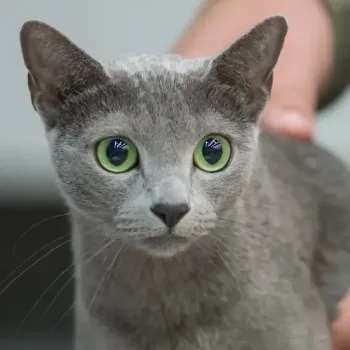
The Russian Blue is a cat breed recognised by FIFe (RUS). It originates from Russia, with its beginnings associated with the northern Arkhangelsk region, though the exact history of the breed's development remains incompletely documented. The breed likely arrived in Great Britain aboard merchant ships and was first publicly presented in 1875 at an exhibition at London's Crystal Palace. This is a medium-sized cat: adult individuals typically weigh approximately 3.6-6.8 kg, with males generally larger than females. A distinctive feature is the short, very dense coat with a plush texture and silvery sheen.
The Russian Blue originates from Russia, with its beginnings linked to the Arkhangelsk region in the north of the country. These cats likely travelled to Great Britain aboard merchant ships. In 1875, they were presented at an exhibition at London's Crystal Palace under the name of Archangel cats. The precise history of how the breed was established remains incompletely documented.
The body is elongated, elegant and well-muscled, with a medium-boned frame. Long, slender legs end in small, oval paws, whilst the fairly long tail gradually tapers towards the tip. The head is wedge-shaped with a flat upper part of the skull. In profile, a straight nose and straight brow line form a distinct angle at the level of the eyebrows. The ears are large, broad at the base and rather pointed. The eyes are almond-shaped, widely set and intensely green. Distinct whisker pads give the muzzle a characteristic expression.
The coat colour is uniformly blue, a blue-grey tone with a pronounced silvery sheen. A clean shade from medium to light is preferred, even across the entire body. The nose leather is blue-grey, whilst the paw pads are dark lavender.
The Russian Blue is typically gentle, intelligent and strongly attached to its owners. Towards strangers it may maintain distance and require time to become accustomed to a new person. In familiar surroundings it readily accompanies household members and participates in their daily activities. It enjoys a predictable daily routine but also needs play and activities to stimulate its curiosity. It readily uses high places for observing its surroundings. It may function well with children and other animals if interactions are calm and introductions take place gradually. It is usually not particularly vocal.
The coat is short, very dense, delicate and soft to the touch. An abundant undercoat causes the hair to stand away from the body, giving the coat its characteristic plush structure. The fur should not lie flat against the torso. Care is relatively straightforward—gentle brushing once or twice weekly usually suffices to remove loose hair and maintain the coat in good condition. The Russian Blue can function well in a flat if provided with places to climb, observe its surroundings and rest peacefully. It can occupy itself during the owner's absence, but upon their return usually readily enjoys joint play and closeness. Some cats learn to retrieve and perform simple tricks, so puzzle toys can provide good enrichment to their day.
The breed is generally healthy and has no well-documented, characteristic set of serious inherited diseases. This does not mean, however, that every cat will be free from health problems. In daily care, particular attention should be paid to body weight. Russian Blues can have a large appetite, and excessive portions combined with insufficient exercise promote obesity. Measuring food, controlling treat portions and regular play help maintain appropriate condition. Any health concerns should be discussed with a veterinary surgeon.
| Organisation | Recognised | Breed code | Category |
|---|---|---|---|
| FIFe | yes | RUS | IV |
- What is the size of an adult Russian Blue cat?
- Adult cats of this breed typically weigh approximately 3.6–6.8 kg, with males generally larger than females.
- Does the Russian Blue require intensive grooming?
- No. Gentle brushing once or twice weekly is usually sufficient to remove loose hair and maintain the coat in good condition.
- Is the Russian Blue suitable for flat living?
- Yes, it can function well in a flat if provided with places to climb, observe its surroundings and rest peacefully.
- How does the Russian Blue behave towards strangers?
- It may maintain distance from strangers and require time to become accustomed to new people, but in familiar surroundings it is strongly attached to its owners.
- What are the most common health issues in this breed?
- The breed has no well-documented, characteristic set of serious inherited diseases, though particular attention should be paid to body weight, as these cats can have a large appetite.