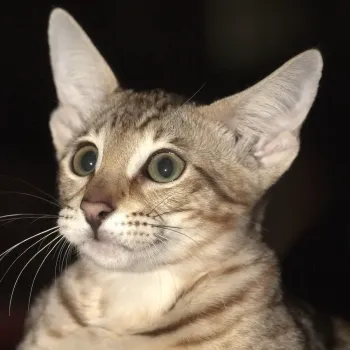
The Savannah is a cat breed recognised by WCF (code SAV). It originates from the United States, created by crossing domestic cats with the African serval. Its distinctive features include an elongated, slender body, exceptionally long limbs and spotted markings. The first documented kitten of this breed was born in 1986 and received the name Savannah, which subsequently became the breed's name.
The Savannah originates from the United States. The breed was developed by crossing domestic cats with the African serval. The first documented kitten was born in 1986 and given the name Savannah, which later became the breed's designation.
Size in Savannahs varies considerably and depends on generation and parental lineage. For example, in fifth-generation (F5) cats, females may weigh approximately 4.5-5.5 kg and males 6-8 kg, though smaller and larger individuals do occur.
The Savannah possesses an elongated, slender and well-muscled body with a deep chest and long neck. Exceptionally long limbs are characteristic, making the cat appear larger and heavier than it actually is. The hind legs are slightly longer than the front legs, and the paws are oval-shaped. The tail is of medium length, fairly thick and bluntly tipped.
The head appears small in proportion to the rest of the body. Very large ears are particularly striking, set high with broad bases and rounded tips. The eyes have a distinctive shape: the upper line resembles a boomerang, whilst the lower line is almond-shaped. All eye colours are acceptable, regardless of coat pattern.
Four primary colour variants are permitted: brown with black spots, silver with black spots, black and black smoke. Spots may be round, oval or elongated, ranging in shade from dark brown to black. In black cats, the pattern may be visible only subtly, appearing as so-called ghost markings.
The Savannah is typically a highly active and inquisitive cat that forms strong bonds with its household members. It readily accompanies its owner, yet displays affection primarily through shared play and following rather than extended periods sitting on laps. The breed learns quickly, and its ingenuity may manifest in attempts to open doors, for instance.
This breed requires daily exercise, interaction and mentally stimulating activities. Savannahs favour high vantage points, climbing and toys that require problem-solving to obtain rewards. Some cats of this breed learn to retrieve and walk on harnesses.
The temperament of individual cats varies depending on generation, socialisation level and individual characteristics. It cannot be assumed that all Savannahs will be equally receptive to strangers or easily accept environmental changes.
The Savannah's coat is short to medium-short, lying relatively flat against the body and not excessively dense. Guard hairs are somewhat coarse, whilst the undercoat is finer. An interesting feature is the softer hair structure within the spotted areas.
Grooming typically involves periodic brushing, which should be more frequent during shedding periods. From an early age, it is worthwhile accustoming the cat to brushing, ear checks, claw trimming and dental care.
A genetic variant responsible for a deficiency in pyruvate kinase, known as PKDef, has been identified in Savannahs. This can lead to anaemia, the symptoms and severity of which vary. A DNA test is available that allows identification of cats carrying this variant, including asymptomatic carriers.
Testing for PRA-rdAc, an inherited form of progressive retinal atrophy, is also available. This condition causes gradual vision deterioration and may lead to blindness. The test detects the specific genetic variant; therefore, a normal result does not exclude other eye diseases.
Any health concerns regarding the Savannah should be discussed with a veterinary surgeon.
| Organisation | Recognised | Breed code | Category |
|---|---|---|---|
| WCF | yes | SAV | — |
- What size range can a Savannah reach?
- Size depends on generation and parental lineage. As an example, fifth-generation females may weigh approximately 4.5–5.5 kg and males 6–8 kg, though smaller and larger individuals can occur.
- How much daily activity does a Savannah require?
- The breed needs daily exercise, interaction and mentally stimulating activities. They favour high vantage points, climbing and toys requiring problem-solving.
- Which coat colours are permitted in Savannahs?
- Four variants are accepted: brown with black spots, silver with black spots, black and black smoke. Spots may be round, oval or elongated.
- Do all Savannahs have similar temperaments?
- No. Temperament depends on generation, socialisation level and individual traits. Not all Savannahs are equally receptive to strangers or readily accept environmental changes.
- Are Savannahs interested in water?
- Many Savannahs show interest in water and enjoy playing with running water, though this is an individual trait that does not apply to every cat of the breed.