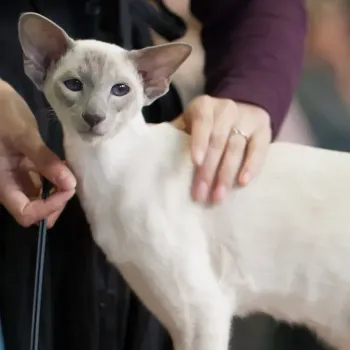
The Siamese is a cat breed recognised by FIFe (code SIA, category IV). It originates from Thailand, formerly known as Siam, where cats with pale bodies and darker markings were documented for centuries. In the nineteenth century, they arrived in Europe, where their unique appearance quickly generated interest. With time, the breed developed a more elongated body shape, slimmer legs and a distinctly wedge-shaped head. This is an energetic and social cat that becomes deeply involved in the lives of its household companions.
The Siamese cat was known in Thailand, formerly called Siam, for many centuries. The breed arrived in Europe during the nineteenth century, where its distinctive appearance sparked immediate interest. Over time, the modern Siamese developed more pronounced characteristics: an elongated body, slender limbs, and a distinctly wedge-shaped head. These refinements transformed the breed into the elegant, recognisable cat we know today.
The Siamese is a medium-sized cat with a light, delicate appearance yet possessing strong musculature. Adult females typically weigh approximately 2-4 kg, whilst males weigh around 3.5-5.5 kg. It has a long, slender body with well-developed muscle tone and a lengthy, fine neck. The limbs are elongated and graceful, with small, oval paws. The tail is very long and tapers gradually to a fine point. The head forms a wedge that widens from the nose towards large ears, broad at the base. The nose is long and straight, flowing smoothly from the brow line. The eyes are almond-shaped, set slightly at an angle, and feature an intense blue colour. The overall silhouette is harmonious, lithe, and elegantly proportioned.
The Siamese is distinguished by its pointed colour pattern, in which a lighter body contrasts with darker markings on the facial mask, ears, limbs, and tail. Available colour variations include seal (dark brown), blue, chocolate, lilac, cinnamon, fawn, red, and cream points. Tabby and tortoiseshell pointed patterns also occur, as do combinations of the pointed pattern with white. Siamese kittens are born very pale, and the darker points develop gradually. Their distribution is temperature-dependent: pigment develops more intensely in the cooler areas of the body, and ambient temperature influences the final shade of the coat.
The Siamese typically becomes deeply involved in household life. It readily follows its owner, observes their activities, and seeks close contact. The breed is well known for its vocal nature, using its distinctive meow to demand attention, play, or food. Extended periods of solitude can be challenging for this cat. It is an energetic, curious, and intelligent breed that enjoys climbing, hunting play, and activities involving food rewards. Some Siamese cats readily learn to retrieve and perform simple tricks. They can thrive alongside children and other animals when interactions are calm and introductions occur gradually. Individual temperaments do vary among cats of this breed.
The Siamese coat is very short, fine, and silky with a characteristic sheen. It lies close to the body, emphasising the slender lines, and the undercoat is barely perceptible. Grooming is not demanding. Gentle brushing removes loose hair and maintains the coat in good condition. It is worthwhile to accustom the cat to such routines from early life, so that they become an enjoyable form of bonding with the owner.
Siamese cats are known to carry an inherited form of progressive retinal atrophy, PRA-rdAc, which leads to gradual vision loss. A DNA test is available to identify the genetic variant responsible for this condition and to detect carriers. The breed has also been documented with amyloidosis, the deposition of abnormal protein in organs, and a predisposition to asthma. This does not mean these conditions will affect every Siamese cat. Persistent coughing and breathing difficulties warrant veterinary consultation. Regular dental checks are also important, as gingivitis, periodontal disease, and tooth resorption can cause pain that may not be obvious to the owner. Oral examinations by a veterinary surgeon help detect these issues at an early stage.
| Organisation | Recognised | Breed code | Category |
|---|---|---|---|
| FIFe | yes | SIA | IV |
- What is the typical weight range for an adult Siamese cat?
- Female Siamese typically weigh approximately 2–4 kg, whilst males weigh around 3.5–5.5 kg. Weight varies according to the individual cat's build.
- What is meant by pointed colour pattern?
- Pointed colouration describes the Siamese characteristic of a lighter body combined with darker markings on the face, ears, limbs, and tail.
- Does the Siamese require extensive grooming?
- No. The Siamese coat is short and silky, and grooming involves gentle brushing to remove loose hair.
- Can a Siamese be left alone for long periods?
- Siamese cats become deeply engaged with their household, and extended periods of solitude can be difficult for them. They require regular contact with their owner.
- What health concerns are associated with the Siamese breed?
- The breed is known to carry inherited retinal atrophy, amyloidosis, and a predisposition to asthma. Regular oral health checks help identify dental problems early.