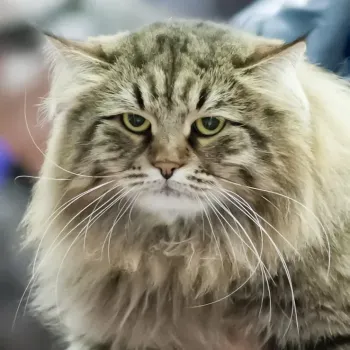
The Siberian is a breed recognised by FIFe (code SIB). It originates from Russia, where its ancestors lived for centuries in a cold climate near farms and settlements, helping to control rodents. The breed developed naturally, with its sturdy build and dense coat being adaptations to harsh conditions. It is a medium to large-sized cat that reaches full physical maturity around the fifth year of life.
The Siberian originates from Russia. Its ancestors lived for centuries in a cold climate near farms and human settlements, where they helped control rodents. The breed developed naturally, with its sturdy build and dense coat representing adaptations to difficult environmental conditions. Beyond Russia, Siberians began gaining greater popularity from the late twentieth century onwards.
The Siberian is a medium to large-sized cat, with females typically weighing around 4-5 kg and males reaching 7-8 kg. Males are distinctly more massive than females. They reach full physical maturity around the fifth year of life.
The coat is semi-long and very dense, with a thick undercoat and a somewhat coarser guard hair that repels water. In winter, the coat becomes more developed, forming a full ruff around the neck, a distinct bib on the chest, and abundant britches on the hind legs. In summer, the coat becomes shorter and less luxuriant. The tail is thick and densely furred, with tufts of hair between the paw pads.
The body is strong and well-muscled, with a robust bone structure. A broad chest and powerful neck emphasise the cat's massive silhouette. The body proportions create a rectangular outline, whilst strong legs of medium height provide stable support.
The head is broad and massive, with gently rounded contours and somewhat longer than wide. The forehead is broad and gently rounded, with well-developed cheekbones. The nose is of medium length, showing a slight indentation in profile without any sharp break. The chin is slightly receding.
The ears are of medium size, broad at the base and rounded at the tips, set fairly wide apart and slightly angled forwards. The inner surfaces are richly furred. The eyes are large and slightly oval, set wide apart and gently slanting. The paws are large and round, with tufts of hair between the toes.
The Siberian occurs in many colour varieties. Solid black, blue, red, cream and white cats are seen, as well as tortoiseshell and tabby patterns. The tabby markings can be classic, mackerel, spotted or ticked. Smoke, silver and golden varieties are also available. Coloured coats may be combined with white, ranging from a small locket on the chest to extensive white areas.
Colourpoint patterning and chocolate, lilac, cinnamon and fawn colours are not permitted.
The Siberian is sociable, affectionate and interested in the lives of its household members. It enjoys staying near its owner, observing their activities and accompanying them in daily routines. It likes being petted and resting close to people, though it also maintains independence.
It has a lively temperament and a strong need to explore its surroundings. It is agile, springy and enjoys elevated places. Play allows it to exercise its agility and natural hunting behaviours. It responds with interest to moving toys and tasks requiring the discovery of hidden objects.
With appropriate socialisation, it adapts well to families with children and other animals. Its activity alternates with periods of quiet rest. Rather than loud meowing, it often prefers purring and soft, chirping sounds.
The coat requires regular brushing, particularly on the belly, the feathering on the hind legs and around the tail area, where mats can form. During shedding seasons, it is worth increasing grooming frequency to remove the loose undercoat.
The Siberian enjoys climbing and observing its surroundings from height. A sturdy scratching post with platforms and safe shelves provide opportunities for movement and rest. Some cats of this breed also show interest in water, watching dripping taps or attempting to catch water droplets with their paws.
The Siberian generally enjoys good health, though it may require care relating to heart, kidney and urinary tract conditions. The dense coat promotes ingestion of fur during grooming, which can lead to the formation of hairballs and constipation. Upper respiratory infections and gum disease may also occur.
Health conditions described in Siberians include hypertrophic cardiomyopathy (HCM), pyruvate kinase deficiency (PKDef), polycystic kidney disease (PKD) and feline lower urinary tract disease (FLUTD). This does not mean that every Siberian will develop any of these conditions.
DNA testing can detect the variant associated with PKDef and determine some inherited coat characteristics. Blood type should be determined before planned breeding or blood transfusion. Heart assessment benefits significantly from echocardiography. The scope of preventative screening should be determined by a veterinary surgeon on an individual basis.
| Organisation | Recognised | Breed code | Category |
|---|---|---|---|
| FIFe | yes | SIB | II |
- How much does an adult Siberian weigh?
- Females typically weigh 4–5 kg, whilst males reach 7–8 kg. Males are distinctly more massive than females.
- Which coat colours are not permitted in Siberians?
- Colourpoint patterning and chocolate, lilac, cinnamon and fawn colours are not permitted.
- Does the Siberian require special coat care?
- The coat requires regular brushing, particularly during shedding seasons. Special attention should be given to the belly, hind leg feathering and areas around the tail.
- Does the Siberian show interest in water?
- Some cats of this breed show interest in water, watching dripping taps or attempting to catch water droplets with their paws.