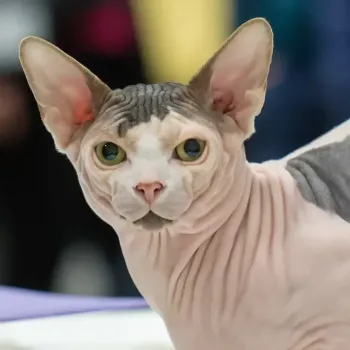
The Sphynx is a cat breed recognised by FIFe. It originates from Canada and arose as a result of a natural genetic mutation, with the breed's history linked to the birth of a hairless kitten named Prune in Ontario in 1966. The Sphynx appears hairless, but its body may be covered with very short, delicate down that feels like soft suede to the touch. It is a medium-sized cat, well-muscled yet heavier than its appearance suggests: females typically weigh 3-4 kg, whilst males weigh 4-7 kg. Its characteristic skin folds are particularly visible on the head and around the shoulders.
The Sphynx originates from Canada and is the result of a natural genetic mutation. In the breed's development, other hairless cats were also used, along with crosses to coated cats, including Devon Rexes.
The Sphynx has a strong, well-muscled build. Its chest is broad and its belly naturally rounded, without excess fat. The hind legs are slightly longer than the front legs. The paws are oval, equipped with long, clearly defined toes and thick pads. The tail is slender and tapers towards the tip.
The head takes on the shape of a modified wedge with rounded contours. It is distinguished by clearly marked cheekbones, a distinct muzzle and a strong chin. The ears are large and broad at the base, with slightly rounded tips. The eyes resemble a lemon in shape and are set slightly obliquely.
All colour varieties and patterns are permitted. Sphynx cats may be solid, tortoiseshell, tabby or have darker point-type markings, as well as any amount of white. With sparse coat, the colouration is visible primarily in the pigmentation of the skin and delicate down.
The Sphynx is typically very sociable, inquisitive and strongly oriented towards human contact. It readily accompanies its owner in daily activities, seeks closeness and enjoys resting against their body. It can clearly demand attention, also through vocalisation.
This is an active and intelligent cat that needs play and activities to engage its curiosity. It typically tolerates prolonged solitude poorly. It may do well in the company of other cats and children, provided interactions are calm and its delicate skin is not exposed to scratching or overly rough play.
The absence of a thick coat does not mean grooming is simple. Oils accumulate on the Sphynx's skin, so regular, gentle cleansing is necessary. The frequency of bathing should be adjusted to the individual cat's needs, using products designed for animals. The Sphynx's skin feels exceptionally warm because we touch it without the insulating layer of fur. The cat needs a warm resting place and readily tucks itself under a blanket or nestles against a person to seek warmth.
The breed is prone to hypertrophic cardiomyopathy (HCM), a disease involving thickening of the heart muscle. Echocardiographic examination allows detection of changes, and checks should be repeated according to your veterinarian's recommendations. A normal result from one examination does not guarantee the disease will not develop later.
Sphynx cats are also described as having congenital myasthenic syndrome (CMS), an inherited condition causing muscle weakness, particularly noticeable after exertion. A DNA test is available to detect the genetic variant associated with this condition.
Sparse coat limits the skin's protection against sun and cold. The Sphynx requires protection from prolonged direct sun exposure, which can cause sunburn. Any concerning symptoms should be discussed with a veterinary surgeon.
| Organisation | Recognised | Breed code | Category |
|---|---|---|---|
| FIFe | yes | SPH | IV |
- Is the Sphynx truly hairless?
- The Sphynx appears hairless, but its body may be covered with very short, delicate down. Hair may occur on the nose, paws, the back of the ears and the tail tip.
- Does the Sphynx have a higher body temperature than other cats?
- No. The Sphynx's skin feels exceptionally warm because we touch it without the insulating layer of fur, but its normal body temperature does not differ from that of other cats.
- Is the Sphynx safe for people with cat allergies?
- The Sphynx can trigger allergies despite its lack of typical fur, as hairlessness does not mean an absence of feline allergens. This breed should not be presented as safe for everyone with a cat allergy.
- Can the Sphynx live outdoors?
- The Sphynx requires protection from prolonged direct sun exposure and needs warmth. Its skin is vulnerable to sunburn and cold.
- Does the Sphynx need regular bathing?
- Regular, gentle cleansing of the skin is necessary because oils accumulate on the Sphynx's body. The frequency of bathing should be tailored to each individual cat's needs, using products designed for animals.