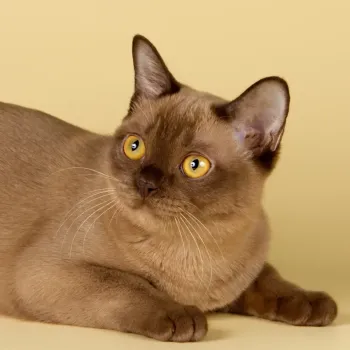
The American Burmese is a cat breed recognised by the WCF (code AMB). The breed emerged in the United States with roots reaching back to Southeast Asia. The female cat Wong Mau, brought to America and distinguished by her brown coat and compact build, played an important role in its development. This is a medium-sized cat, powerfully muscled and surprisingly heavy relative to its size. It is characterised by a satin coat and a strong need for contact with its owner.
The American variety of the Burmese cat developed in the United States, although its genetic roots lie in Southeast Asia. Adult male cats may weigh approximately 5.5 kg or more, whilst female cats are typically smaller and lighter.
The American Burmese has a compact build with strong bone structure and well-developed muscles. The chest is broad and rounded, and the back forms an even line from the shoulder blades to the base of the tail. The limbs are proportionate to the body, with rounded paws and a straight tail of medium length.
A characteristic feature is the distinctly rounded head both from the front and in profile. The cheeks are full and transition into a broad, short muzzle, whilst between the forehead and nose there is a distinct break in the profile. Ears are medium-sized, set wide apart and slightly tilted forward. The eyes are large, round, and range from yellow to golden in colour.
The breed is characterised by four primary coat colour variants: Sable, a deep, warm sable brown; Champagne, a light, warm beige with a honey tone; Blue, a blue with a delicate, warm undertone; Platinum, a light, silvery grey with a subtle fawn undertone.
The coat should appear even in colour, with permissible delicate lightening of the underparts. The final depth of colour may develop as the cat matures.
The American Burmese typically shows a clear need for contact with people. It readily follows household members, seeks out laps and participates in daily activities. It is affectionate, curious and can firmly demand attention. Long periods of solitude can be difficult for it.
It is also an intelligent cat and keen to play. It enjoys interactive toys, simple tasks and shared activities; some individuals readily retrieve. It typically communicates in a gentle voice, but can firmly remind its owner of its needs. It may function well with children and other animals if introductions progress gradually and its boundaries are respected. Many Burmese cats retain an interest in play even in their senior years.
The coat is very short, delicate and lies close to the body, with a satin sheen. Grooming is not demanding. Usually gentle brushing once a week with a soft rubber brush is sufficient to remove loose hairs. Regular bathing is not necessary if the cat keeps its coat clean.
In some American lines of this breed, a variant of the ALX1 gene associated with Burmese Head Defect (BHD) occurs. Possessing two copies causes severe abnormalities in skull and facial development, making survival impossible. A cat with one copy does not have this severe defect, but may pass the variant to offspring. A DNA test is available to detect the presence of this variant.
Hereditary hypokalaemia has also been described in Burmese cats, associated with reduced potassium levels and episodic muscular weakness. It may manifest as difficulties in walking or maintaining the head in the correct position. A DNA test is available for this genetic form, allowing identification of asymptomatic carriers as well. This does not mean the condition occurs in every individual of the breed.
Any health concerns require consultation with a veterinary surgeon.
| Organisation | Recognised | Breed code | Category |
|---|---|---|---|
| WCF | yes | AMB | — |
- How do I choose a breeder of the American Burmese?
- Check on the cattery page which federation the cattery belongs to. Ask the breeder about the parents' health tests and the kitten's pedigree. Arrange a visit and see the cats in person.
- What is the average weight of an adult male cat?
- Adult male cats may weigh approximately 5.5 kg or more, whilst female cats are typically smaller and lighter.
- How often should an American Burmese be brushed?
- The coat requires only gentle brushing once a week with a soft rubber brush to remove loose hairs.
- Does this cat tolerate long periods alone?
- The American Burmese very much needs contact with people, and long periods of solitude can be difficult for it.
- What are the primary coat colours?
- The breed has four variants: Sable (deep sable brown), Champagne (light honey beige), Blue (blue with a warm undertone) and Platinum (silvery grey).
- Do all cats of this breed have genetic problems?
- Not all American Burmese cats have health problems. Whilst genetic variants occur in the breed line, they do not affect every individual. A veterinary surgeon can be consulted regarding individual risk.