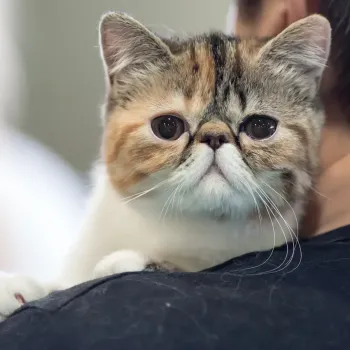
The Exotic is a cat breed recognised by FIFe. It was developed in the United States through the crossing of Persian cats with American Shorthair cats. This combination resulted in a cat with the rounded build of a Persian but with a short, dense coat. It is characterised by a calm temperament and strong attachment to its owners. It is considerably less demanding in grooming than a Persian, although its coat still requires regular care.
The Exotic was developed in the United States in the 50s of the 20th century. The breed was created by crossing Persian cats with American Shorthair cats, producing animals with the build of a Persian but with a short and dense coat. In 1967, the breed achieved championship status in the CFA.
The Exotic is a medium to large-sized cat, with adult females weighing approximately 3.2-5.4 kg and males 5.4-6.4 kg. It is characterised by a compact, well-muscled frame with a broad chest, powerful shoulders and strong back. The legs are short and sturdy, ending in large, round paws. The neck is short and powerful, the tail short, proportionate to the body and well-coated. The head is round and massive, with a broad skull, full cheeks and a strong chin. The ears are small with rounded tips and set low, positioned far apart. The eyes are large, round and widely set. The nose is short and broad, with a distinctive break in profile between the eyes, and the nostrils should remain well open to allow free airflow.
Acceptable colours include white, black, blue, chocolate, lilac, red and cream. Tortoiseshell, tabby, smoke, silver and golden varieties also occur, as well as their combinations with white. Colourpoint variants are also available with darker markings on the face, ears, legs and tail. Eye colour is related to the coat colour variety.
The Exotic is typically gentle, calm and strongly attached to its owners. It enjoys being close to people, resting in their company and receiving affection, though it does not demand attention in a particularly vocal manner. It combines a calm disposition with curiosity and a love of play, readily taking interest in a moving toy before returning to its favourite resting spot. It can get along well with children, other cats and dogs, provided interactions are gentle and introductions are made gradually. It usually feels at ease in a quiet home with comfortable resting places and a predictable daily routine.
The Exotic's coat is short, very dense, soft and plush-like. The abundant undercoat causes it to stand away from the body, emphasising the rounded silhouette, and should not lie flat against the torso. Grooming is less time-consuming than in Persians, but requires regularity. Usually thorough combing once a week is sufficient, though more frequent combing is needed during heavy shedding. Removing loose undercoat helps prevent matting. A neglected coat can form mats despite the short hair length.
The breed is affected by hereditary polycystic kidney disease, PKD, which involves the development of cysts in the kidneys that can gradually impair their function. A DNA test is available to detect the genetic variant associated with the disease. Screening for the hereditary form of progressive retinal atrophy, PRA-pd, is also important, as this leads to reduced vision and blindness. A genetic test is also available. The presence of these diseases in the breed does not mean they affect every cat. The shortened skull structure requires particular attention when assessing the cat's breathing and comfort. The eye area should be checked regularly and gently cleaned. Persistent tearing, irritation and breathing difficulties warrant veterinary consultation.
| Organisation | Recognised | Breed code | Category |
|---|---|---|---|
| FIFe | yes | EXO | I |
| CFA | yes | — | — |
- How do I choose a breeder of the Exotic?
- Check on the cattery page which federation the cattery belongs to. Ask the breeder about the parents' health tests and the kitten's pedigree. Arrange a visit and see the cats in person.
- What is the difference between an Exotic and a Persian?
- The Exotic has a very similar build and temperament to a Persian, but its coat is short and dense rather than long, which significantly reduces grooming requirements.
- How often per week should an Exotic be combed?
- Usually thorough combing once a week is sufficient, though more frequent combing is needed during heavy shedding.
- Can Exotics have health problems?
- The breed can develop polycystic kidney disease (PKD) and progressive retinal atrophy (PRA-pd). DNA tests are available. Regular monitoring of the eyes and breathing is also essential.
- Does an Exotic require a lot of space?
- It usually feels at ease in a quiet home with comfortable resting places, though it may take an interest in play.
- Is the Exotic friendly with children and other animals?
- It can get along well with children, other cats and dogs, provided interactions are gentle and introductions are made gradually.